
Rendered in Light, مَرسوم بالضوء | Faith, healing and endurance in Gaza
4 March 2026 | Maria Marrone
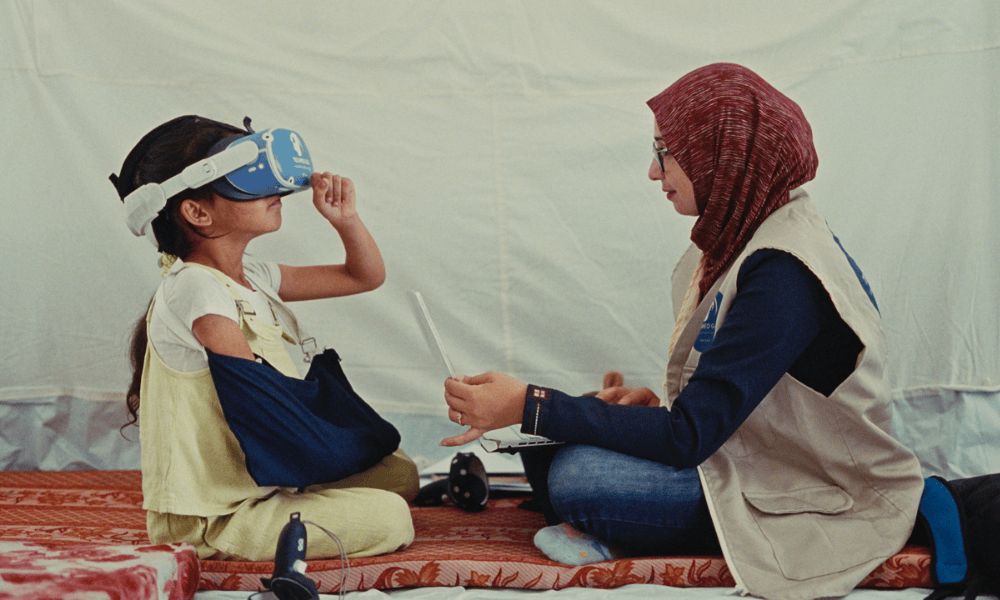
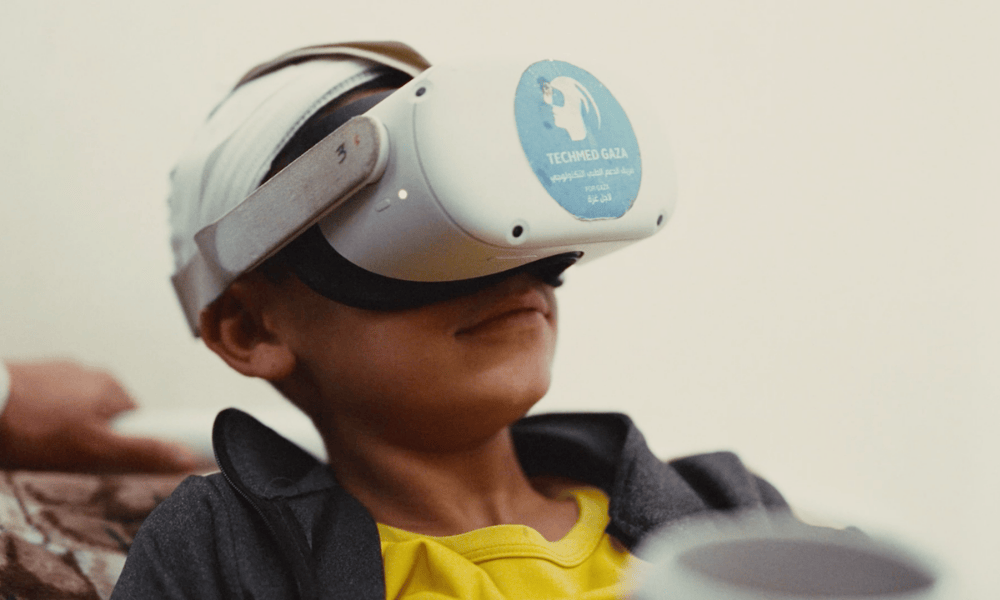
When Mosab, a skilled software engineer, is separated from his wife and children as they evacuate Gaza for emergency medical care, he’s left behind with only uncertainty and a laptop. Alone in a city under siege, he begins building something extraordinary: a virtual reality program designed to help survivors of genocide cope with mental trauma. As genocide rages around him, Mosab immerses himself in creating digital worlds of calm and reflection. The film follows his journey as he balances the emotional weight of his own loneliness with a relentless drive to serve others. Through acts of kindness and innovation, he finds a way to preserve his own mental health, turning grief into action, and despair into purpose. His work and the benefit it brings his community eventually makes him a target for Israel.
In early 2025, I wanted to offer my filmmaking services to Techmed Gaza as a means of creating a contained piece that would then allow them to apply for funding to expand their program. With the support of Techmed and The Sameer Project, I was able to source a team of young cinematographers, whom I would then spend hours speaking to on WhatsApp, using Google translate or with a live translator, trying to consolidate the vision of the film. We wanted to capture the story of Techmed through the testimony of its founder Mosab Emad Ali.
I have a hard time talking about this film without talking about God. The genocide in Gaza as a whole has been impossible to process without the consideration of the unseen. Beyond the social and political dimensions of this movement, it becomes irresponsible to ignore the spiritual warfare at play as well. True healing in Palestine requires more than rebuilding infrastructure. It demands recognizing the spiritual structures that have carried people through unimaginable loss. My only solace as a witness and as a Muslim has been the reminder that this will all be reckoned with.
The closest I’ve ever been to Gaza was when I did a volunteer mission in the West Bank in 2019. There is no point of comparison in the experience of violence between the two places, the West Bank being in close proximity to the occupation, and Gaza an open-air prison where the traces of the occupier arrive as bombs that fall from the sky. One thing I walked away with from that experience was the way in which the evil of the occupation coexisted with the innate beauty and baraka [blessing] of the land. All religions of the book have connections to this land and you can feel the breath of prayers in every open field. It was that magic that I was most inspired to capture in the visual language of this film.
The question of faith is central to this story for a variety of reasons. The lens through which the story is told is derived from the Quranic quote, “inna ma’al usri yusra” [94:5-6]. The verse speaks about how hardship comes with ease, not as a prerequisite or a chronology, but as a symbiosis. Even in the darkest moments, windows of breath and softness can arise to give you fortification to continue in your plight. In every struggle there are moments of warmth, order, and normalcy that invite a quiet gratitude that scaffolds the heart.
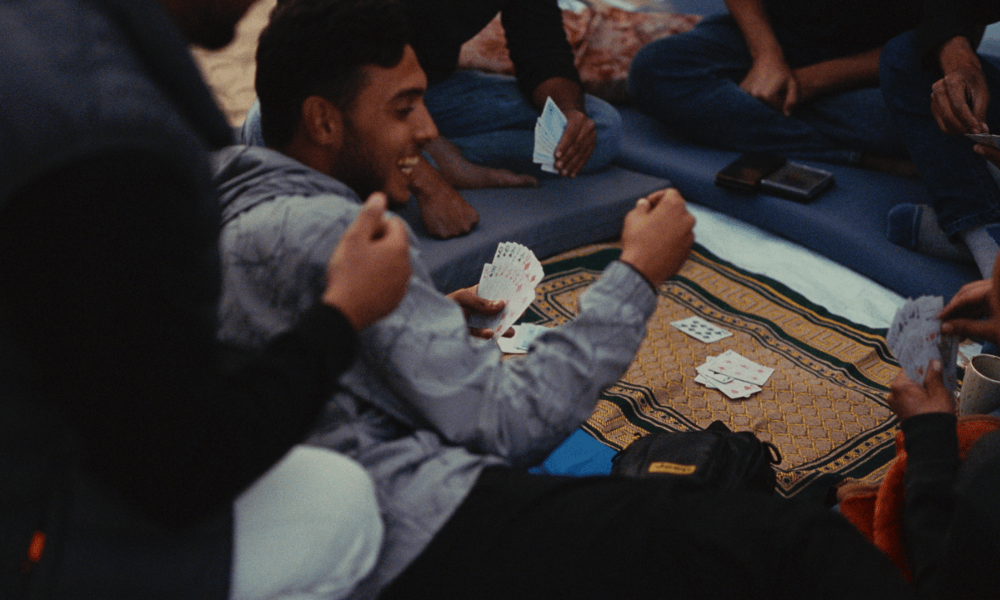
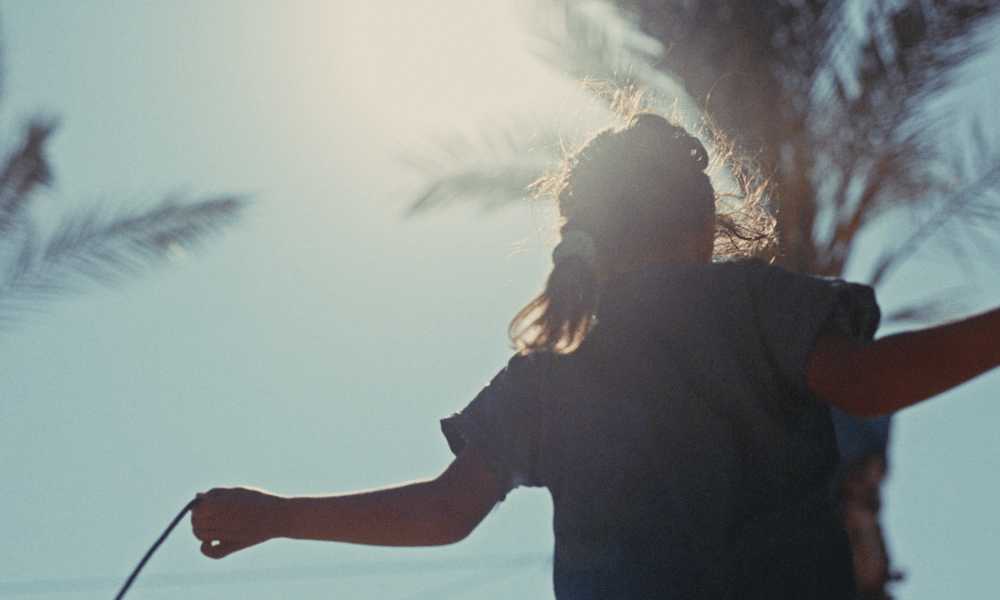
The visual language of the film focuses on these moments: mothers brewing tea for their families, young men laughing and playing cards, the glow of the ocean at sunset, children playing outside. Palestinian land holds a very sacred energy, and that was something we tried to bring forth in the film. The intention was to illustrate that the rubble, the concrete, and the ashes are the creation of an other, less human anomaly. That which is living, whether it be the earth or the routines Palestinians build for themselves, remains and endures.

In my experience with Mosab (Allah Yerhamu), but also through the team in Gaza and the videos that have circulated across our screens, one of the most profound and radical things I’ve witnessed is the notion of fostering and stewarding life as a divine expectation. One’s capacity to engage with that practice becomes the means by which self-worth and self perception are shaped. We’ve seen this in young men volunteering to extract people from underneath the rubble, in doctors running across open fire to tend to their patients, in school children sharing the little food they have with stray cats.
Everything we claim to know in the Global North about collective care and radical community work looks feeble when we are also chronically self-obsessed and invested in our comfort and pleasure. To witness collective action at this scale as a healing mechanism transformed my understanding of liberation and cemented the belief that people with this belief system can never be beaten.
Something foundational to people with this level of God-consciousness is the focus on the presence of blessing rather than the grief of absence. Because of this, it’s no surprise that some of the most moving scenes we’ve witnessed on our screens are those of people experiencing unfathomable loss and praising God as their first reaction. Any and all rampant Islamophobic rhetoric used to justify this genocide becomes baseless when met with this reality. As Mosab states toward the end of the film, the God-consciousness of Gazans has held a mirror up to the world, forcing a recontextualization of the narratives we’ve been conditioned with and inviting an examination of our complicity and global apathy.
Mosab’s entire motivation for drowning himself in work was the desire to bring dignity and ease to his community, to carry the burden of his grief through service. Coupled with this was the acknowledgement that given the ruthlessness of the military occupation, death could arrive at any moment. He wanted to be ready to meet his Creator having successfully and patiently endured the trials of genocide, including the darkest parts of survival.
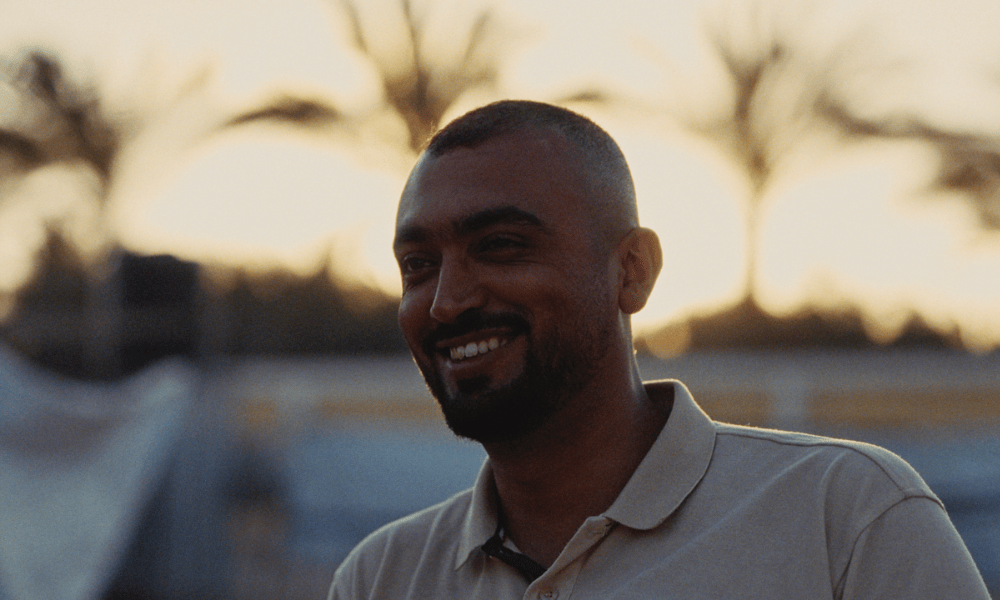
Mosab Emad Ali, founder of Techmed
If people in the Global North were fist-fighting over rolls of toilet paper after a few months of quarantine, there’s no doubt that people in Gaza have had to grapple with the lowest parts of their survival mechanisms. One of the statements Mosab made that most touched me was how this constant proximity to death became a vehicle for purification, holding himself accountable, and striving toward excellence. In a world where flaws of character are often attributed to trauma, the notion of pain as a catalyst for goodness humbled me tremendously.
One of the things that was especially important to me was including moments where Mosab would begin meetings by sending peace and blessings upon the messenger of God [PBUH], or where he would declare God’s singularity while washing his face, or whisper remembrance in moments of frustration. Apart from the awe these moments brought me as a Muslim watching another Muslim keep God present in every affair, it was an intentional choice to recontextualize what these words mean. All too often, brown Muslim men are depicted uttering such phrases only in acts of violence. Here, these words are soft whispers that bring ease to the wounded heart of a man trying to care for those around him, while witnessing his children grow through a mobile screen.
Like so many men captured in the strife of protecting their families and communities, he offers nuance when thinking about divine masculinity and the stewardship attached to it. He challenges all rhetoric that reduces this to machismo or control. He challenges all language that dehumanizes Muslim men, rendering them cartoonish and one-dimensional figures from whom women and children must be saved.
When it comes to mental health, there is also the question of the politics attached to healing and recovery. Too often, Western agents and aid organizations want to see women in hijab doing yoga and call it a successful mission. Modern psychology’s fixation on a secular worldview is largely inapplicable to a community like this. Agendas emerge, exertions of control and cultural exports within the NGO sector that dictate what help, healing, and betterment are meant to look like. Rarely does the approach integrate the specific needs of the community or the severity of the trauma. Ethics and care are lost beneath bureaucracy, and the spiritual health of the community is disregarded. Mosab’s initiative was unique precisely because it was Palestinians designing healing for Palestinians, integrating cultural relevance, centering faith, and reclaiming agency.
That this initiative was developed during the hardest chapters of the genocide illustrates that healing can happen in the now, not only in some imagined “after.” It shows a refusal to be defined by what is being done to people, and instead by how they problem-solve and narrate their own lives. As the world turns toward recovery and reconstruction, humanitarian work must grapple seriously with faith. Ignoring that spiritual foundation risks repeating the same paternalism that has long plagued global aid work. If this moment has taught us anything, it’s that the systems we’ve taken for granted must be re-examined and reimagined, built on the voices and values of those who’ve endured the most.
I feel a deep sense of anxiety speaking about Mosab because I don’t believe anything I say can truly do justice to the level of care and kindness he embodied. Throughout the process of making this film, my spirit was in a constant state of prayer, waiting for the moment I could share it with him. Every time the internet shut off and I couldn’t reach people, my heart became tachycardic with fear for their safety. During the height of the famine, Mosab became ill, and once again my chest tightened with worry. And yet, there was a quality about him that made him seem invincible. Even the meaning of his name, derived from the companion of the Prophet [PBUH] Mus‘ab ibn Umayr, carries connotations of resilience, steadfastness, and refinement through hardship, of something that endures.
My final interview with him took place two weeks before he was killed. While we spoke at length about the weight of responsibility he carried through his work, we spoke very little about his own relationship to mortality, or what his body was enduring amid illness, hunger, stress, and exhaustion. One of the hardest moments for me still is remembering the way he smiled in the face of death. The radiance of his smile, the tranquility in his eyes, made me believe him when he spoke. Hearing him say those words in real time over the phone moved me deeply. I found myself wondering what kind of trials a heart must endure to be ready to meet its Creator, and confronting my own deficit in that kind of bravery…especially knowing that he was barely three months older than me.
His assassination filled me with anger. Even now, the only way I can make sense of it is through surrender to God’s divine decree. It’s something I cannot comprehend within my limited human perception. My encounter with Mosab has reshaped my relationship to storytelling and unsettled my sense of purpose within it. I am still trying to understand what that means. Perhaps I will always remain a rookie storyteller. But what I feel deeply blessed by is the opportunity to have captured the story of a man who sought to fulfill what he believed was his purpose on Earth: to give meaning to his pain and to live in service. If there is any hope I hold for what this film might accomplish, it is simply this: to bear witness to his testimony.