

Sophie Simnett would rather you watched her characters. Here she is anyway.
by María José Rubio
When Sophie Simnett was at nursery, she discovered a fake phone box. A prop, presumably intended for imaginative play in the broadest sense: a colour, a shape, a thing to hold and put down. Except she didn't put it down. She stood inside it and talked to herself, or to no one, or to everyone, for hours. Her teachers didn't know what to do, and it was only once her mother shared that story with her a few years ago that something clicked: she realised other children hadn't done the same. "I thought everyone's mind was like that," she tells me, laughing. It wasn't the fact that others found her everlasting conversations on the fake phone peculiar that she was interested in, but rather it was a confirmation of a suspicion she'd long had, that creating and telling stories were a tool for her survival.
It’s a balmy Friday in April, and we are on the set of Short Stuff's first cover shoot. Simnett’s warmth radiates in a way that makes you realise how rarely you encounter it without force or effort. She is also interesting in ways that her IMDb doesn't prepare you for. We’re here, ostensibly, to talk about two short films, one she's acted in and one she's directing, but the conversation keeps pulling us somewhere else. As she sips on herbal tea, the afternoon light washing over her, we find ourselves discussing what it costs to make things, who gets to decide what a person is worth and, most importantly, how her self-awareness and ability to feel things makes everything she touches so much more layered.
There was something else that made our conversation and, by proxy, Simnett, more captivating. Journalists will understand how boring it can be to write about someone who loves being written about, who has lost themselves somewhere between their characters, their audiences and their dreams. Simnett is almost the antidote to this. "I want people to see my characters, not me," she tells me at one point, with the directness of someone who has thought about this carefully. She would rather you watched her characters than her. Yet here we are, doing this interview. The irony is not lost on either of us.
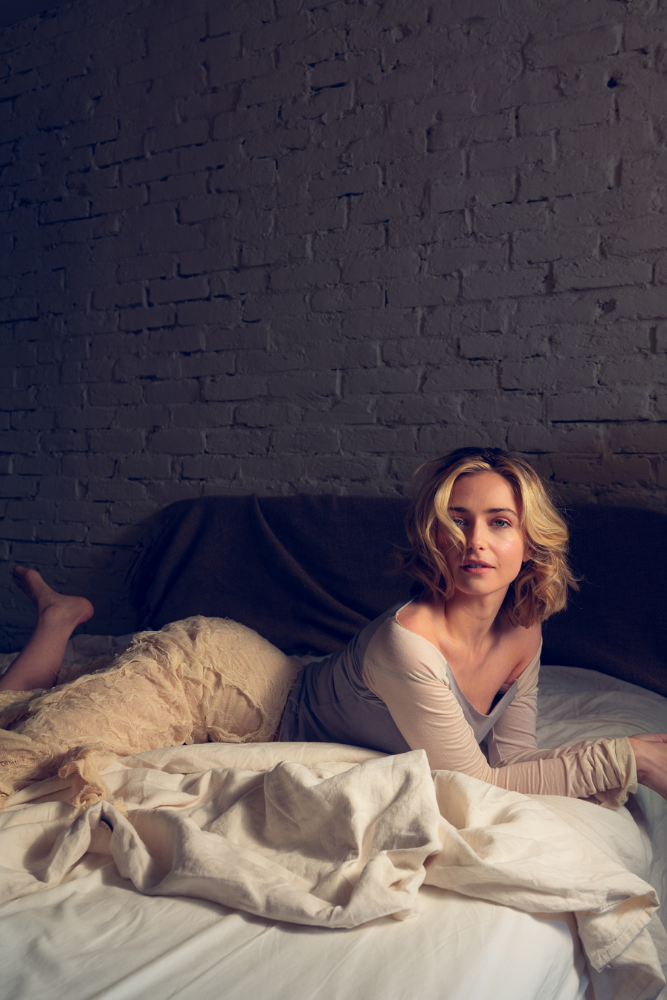
Sophie wears Springtime Wishes I Photography by Donna Ford for Short Stuff
By her own account, she didn't grow up in a ‘film household’, but that didn't stop her from taking acting classes from the age of seven, badgering her parents until they agreed. There's an entire generation that grew up dreaming of being pulled out of class to go to a call-back or secretly faking a doctor's appointment to attend an audition; Simnett was living it. While at school, she quietly built a career in parallel, missing months of lessons to film The Lodge for Disney next to the likes of Luke Newton and Dove Cameron. At eighteen, she turned down multiple university offers to act full-time. She bet on herself and nobody, least of all her, seems to have second-guessed it.
What tends to get overlooked in this origin story is how much she was already doing, long before anyone started counting her followers. At school after PE, presumably still in her kit, she directed a play her friend had written at the Lyric Hammersmith. She paid the actors with money raised by selling sweets out of her locker. They sold out their week-long run. She loved it.
Then life happened in the way it does in your early twenties, or at least, she says it like she suspects it did for the rest of us too: "All-encompassing in a way that nobody makes films about. They make films about teenagers and people in their late-twenties, but this early transition period, you think you're being treated as an adult, and you kind of feel like a child, but don't want to be treated like a child. Everything is so big and so intense."
So the directing receded and she took to photographing film sets instead. She became a regular at a studio, shot portraits, and worked doing BTS on productions. She describes her photographic approach as trying to find, “the in-between moments, rather than the obvious shot."I reflect on this. It is the same sentiment that encompasses how Simnett moves through the world: teaching herself to see, and learning how she would eventually allow others to perceive her.
Over lunch, Simnett makes an aside about a famous actress that provokes an interesting discussion. Some people see what she means, others disagree. It's a nothing moment, really, but Sophie’s reaction to the disagreement, small as it was, stays with me. Not because what she said was bad, far from it, but because of what it reveals about the vigilance involved in being Simnett: the constant, low-level calculation of how the thing you're about to say will land, who it'll make you, which box it'll confirm or crack.
She has spent a lot of her career navigating this: the particular friction of being someone whose inside and outside have never quite matched what any given context required of her. Too sensitive for a household that didn't share it. Too private for an industry that runs on access. Too interior, perhaps, for platforms built to reward the most exterior version of yourself.
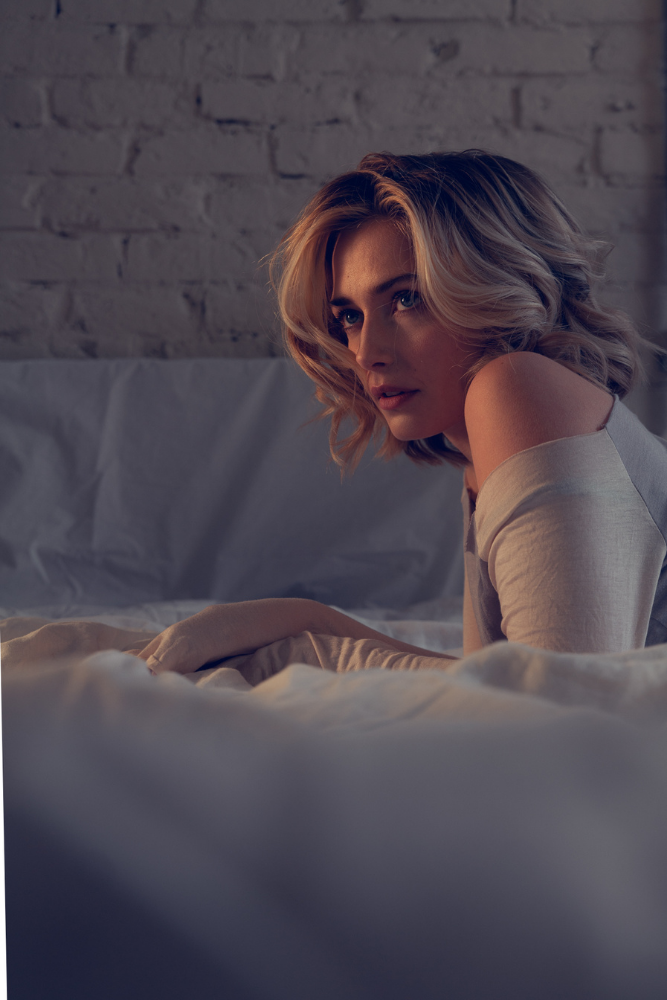
Sophie wears Springtime Wishes I Photography by Donna Ford for Short Stuff
After The Lodge came Daybreak, Netflix's post-apocalyptic comedy series that she once described, accurately, as what happens when Mad Max, Ferris Bueller, Stranger Things and The Breakfast Club have a baby. It was the kind of breakout that arrives with a lot of noise, even when the show got cancelled. Simnett had made it, not just to thousands of people’s living rooms, but also to millions of people through their handheld screens.
She found she couldn't locate a version of herself that felt true in that format. "I'm a one-on-one person," she says. "One to thousands is just too much." So she stepped back into her life, away from strangers’ expectations and anonymous approval. For a while, it felt like the right thing, until it wasn't; until she started losing jobs because she didn't have the following for them. The work she was perfect for, the rooms she wanted to be in, turned out to require a currency she'd stopped collecting. Her arm was twisted.
But by this point, she had learned the push and pull of the world she had inadvertently chosen. She morphed into a version of herself she'd agreed to make available – “The me I'm choosing to share rather than the me I know deeply,” as she puts it. She uses this persona only for work now, and has arrived at something approaching equanimity about the distinction, though it still produces the occasional friction. "It's so weird to think of it all as business when the actual work is so emotionally intimate." The profile shoot, the posed photo, the caption; these are characters she plays, they just happen to share the same face.
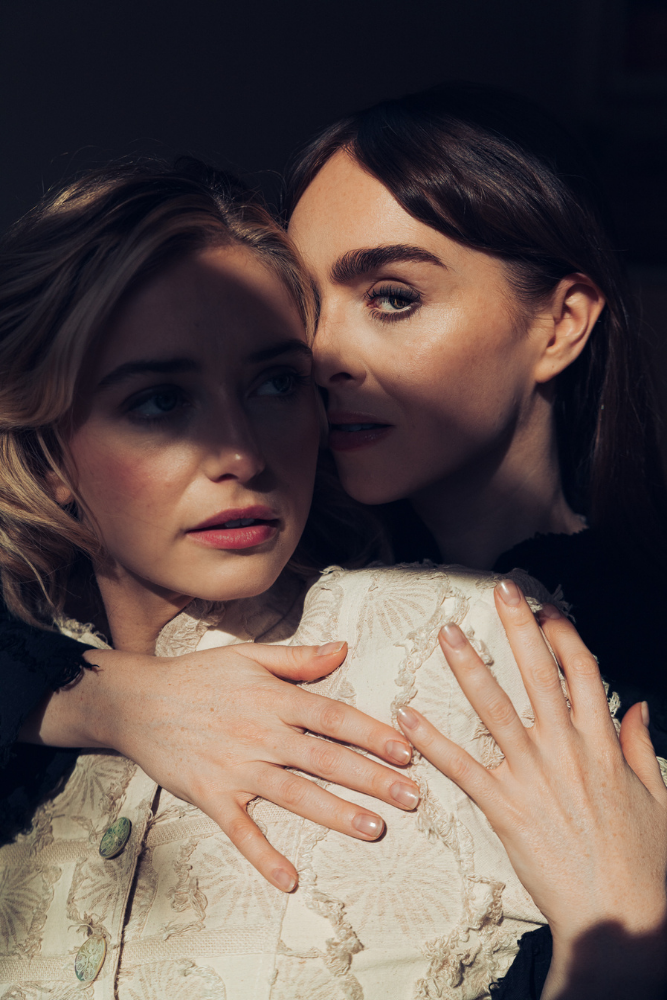
Sophie and Louisa wear Springtime Wishes I Photography by Donna Ford for Short Stuff
At some point during lockdown, Simnett sat down and wrote a script. It started as live action and although producers liked it, they argued the themes would be difficult to achieve on budget. She could have rewritten it, but instead she spent months watching stop motion films and adapting the script to this new format. She'd always been drawn to animation, never seeing it as a step down or a step prior to live action, and the form had been sitting inside her, patient, waiting.
The script became The Bay: on a remote coastline, GIRL tries to scatter her mother's ashes. Across the sea, BOY lives trapped in a lighthouse, hearing impaired, a beam of light his only connection to the world outside. “...their connection offers solace beyond words”. Magical realism plays an important role in the story, as it highlights the necessity of emotional communication “in times where language may fail us”. It’s due to be shot on film, with puppets built to sign BSL accurately (down to a puppet-sized hearing aid), “I want The Bay to feel timeless both in story and in aesthetic,” Simnett says, and explains that only film allows for certain tactility and textural elements that are key to telling this story. Going to those lengths pushes far beyond making a statement for the audience; it’s proof of how much of the filmmaker’s soul was poured into the project.
The idea for the story came from being "extremely sensitive" in a family that was much less so, the feeling that something is wrong with you and the isolation that comes with it, especially as a kid. Simnett grew up to be independent by necessity rather than choice, always between groups and thinking she’d forever self-define as “kind of a floater”. It took her entire twenties to find what she calls her “five girls” – any woman of any age will know how meaningful and life-defining this is. She doesn't necessarily draw the thread between those scenes of life growing up and this film, but she doesn't need to. "We all feel it every day," she says. "We just hide it." And when children don't have the tools to process it? "You kind of become smaller and smaller".
The story of how the actor-director-writer became involved in The Intimacy Coordinator starts with her meeting director Louisa Connolly-Burnham through photographer Tyler Shields at a shoot in 2019. They played an old-fashioned couple, Connolly-Burnham in a vintage dress and Simnett in pinstripe trousers and a baker boy hat because she was, as she puts it, "really interested in exploring masculinity." They kissed under a bridge in Maida Vale.
Connolly-Burnham’s previous short, Sister Wives, was longlisted for a BAFTA and won over 50 festival awards. When The Intimacy Coordinator came up (a darkly funny psychological thriller about an intimacy coordinator who is also a sex addict) Simnett didn't ask about the size of the role. Being in the room was enough for her. It is, she says, exactly the kind of room she wants to be in: led by women with space for female roles that are layered and interesting, where the passion runs through every person that’s present.
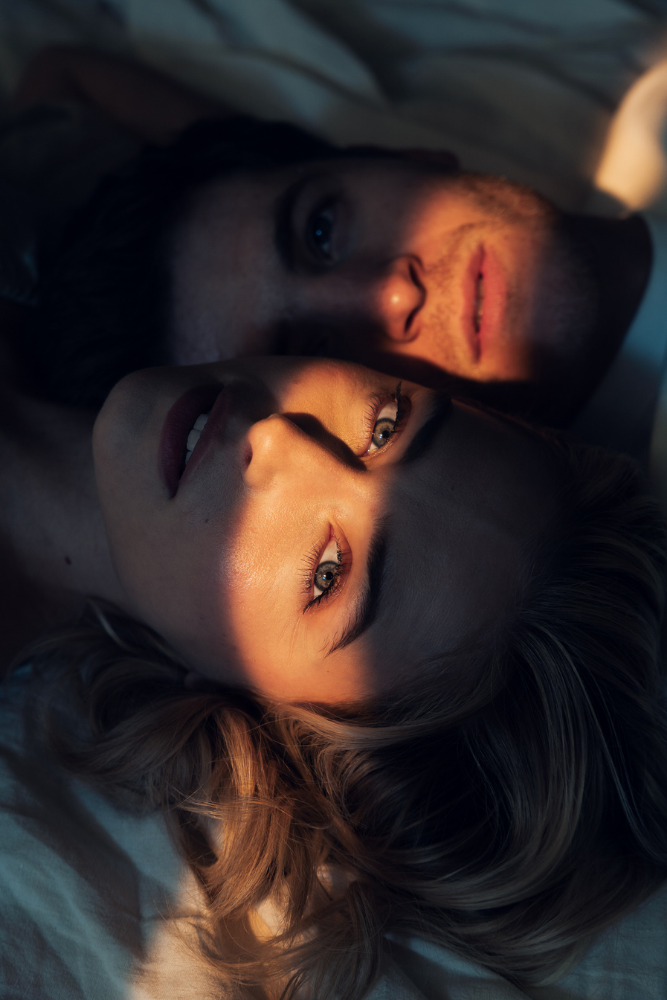
Photography by Donna Ford for Short Stuff
At the end of our conversation, I ask Simnett what brings her joy and she treats this question like a gift. The cherry blossoms are out, she says. She just started tap dancing lessons (add yet another layer to the multi-dimensional woman that she is). She subscribes to a printed newspaper from New Zealand called The Hat (only happy news) and every morning she has her cacao and reads about an unlikely animal friendship or a stranger being quietly kind somewhere in the world. It sounds cliché, she says, pre-empting me and, once again, trying to protect how she will be perceived before it even happens. But it doesn't sound cliché to me. It sounds like someone who has thought carefully about how to stay soft in an industry that rewards hardness, and decided to do it anyway whilst staying true to herself.
I think back to the phone box: young Simnett standing inside it for hours, not knowing how far her wondrous mind would take her, still talking, still making, still finding forms for things other people leave unnamed. It occurs to me that every choice she's made, in one way or another, has been in pursuit of a container large enough to hold all of it. Directing got her closer. Stop motion closer still. And somewhere in the middle of all of this, between the joy and the loneliness, the internal negotiations and the ventures into new places, she says something that I haven't been able to shake. Something that clearly defines why she does what she does. About photos and grids. About what they can hold, and, more importantly, what they can't.
"You can't have a photo which shows every aspect of you."
A pause.
"That's why we love film."