Review: ‘Man Enough’, by Alfie Jallow & Beru Tessema – An intimate and layered look at family, queer love, and trans identity
27 Jan 2026 | Beth Noble
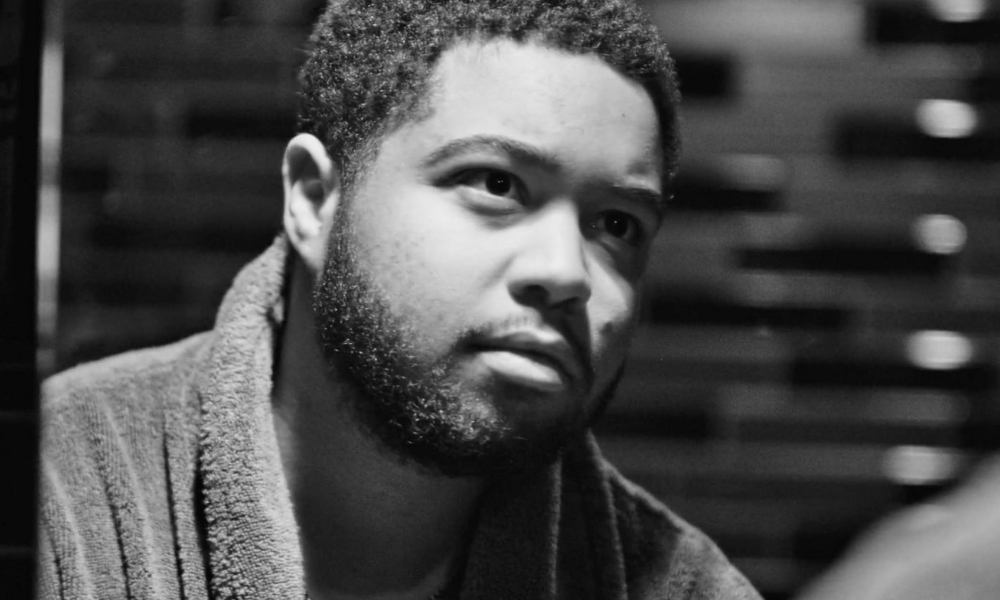
Director: Beru Tessema
Written by: Alfie Jallow & Beru Tessema
Producer: Pamela Jikiema, RADA Films
Selected for the Iris Prize (2025)
Shot entirely in black and white, with an almost documentary restraint, Man Enough feels like a family portrait: still, observational, and emotionally loaded. Nothing is heightened; everything feels lived-in. This aesthetic choice flattens warmth and distance alike, leaving the viewer to sit with moments exactly as they are, unresolved and exposed.
The story follows Caleb and his girlfriend Mia as they travel across London to visit Caleb’s sister Annie, her partner Jason and their new baby. When they arrive, it becomes clear that this is the first time Caleb’s sister has seen him since his transition, and while she showers him with love and pride, Jason is clearly not comfortable.
The film opens with tender, deliberate shots of Caleb, played beautifully by the film’s writer Alfie Jallow, preparing for his day. He follows a YouTube tutorial on trimming his beard and applies bio-oil to his top surgery scars, moving through these rituals with quiet focus. There’s an intensity brewing here, though we aren’t yet sure why. Masculinity is presented as practice – careful, private, and deeply personal.
As the 23-minute film unfolds, we meet Caleb’s girlfriend, Mia (Bella Aubin), whose unwavering loyalty grounds the film emotionally. She accompanies him across London to visit his sister Annie (Joanie Diamond), her partner Jason (Charles Entsie), and their new baby. Set against the city’s muted urban backdrop, the journey is quiet and intimate. As viewers, we’re right there with Caleb and Mia – moving forward without knowing what awaits them.
When Caleb’s first attempts to buzz in go unanswered, he puts on a brave face and shouts to Jason, who reluctantly comes to the gate, coldly claiming not to recognise him. It quickly becomes clear this is Caleb’s first time seeing his family since his transition. Annie rushes out, embracing him with fierce love, and for a moment the undercurrents of transphobia surrounding them seem to fall away, only to resurface in an ignorant, backhanded comment from an old friend: “You look more like a man than me.”
Inside the house, Man Enough skillfully captures the complexity of attempted reconciliation. Annie’s clumsy efforts to reconnect are imperfect but sincere, quietly juxtaposed with the effortless understanding and loyalty between Caleb and Mia. Outside, however, the tone shifts sharply. Jason and a friend lift weights, blast music, and brood, their toxic masculinity and male fragility rendered loud, physical, and increasingly hostile. Most striking is Jason’s focused fixation, watching Caleb through the window, his gaze loaded with anger and control.
The tension reaches its peak when Annie hands Caleb the baby. Jason storms inside, demanding his son back and ordering Caleb to leave. From this point on, dialogue falls away, but the pain and quiet acknowledgment of the violence Caleb has just endured rings loudly. It is here that the performances shine, doing the work that words cannot.
In the final scene, Caleb is allowed a brief, fragile moment with his nephew. As the credits roll, we continue to watch as the vibe seems to shift – Jason is smiling, he and Caleb are chatting, Mia is no longer burning with anger. There is no closure here, only continuation. This is a person in motion; a family mid-journey.
Man Enough is a poignant and restrained exploration of becoming, of masculinity defined not by dominance or ownership, but by care, endurance, and love that persists even when it isn’t fully welcomed. Quiet, observational, and deeply affecting, Man Enough understands that acceptance is rarely a single moment. More often, it is something survived.