Review: ‘Flint’ by Naqqash Khalid – A quiet reflection on confronting inherited pain
25 Feb 2026 | Beth Noble
In January, we shared exclusive first look photos of Naqqash Khalid’s new short film Flint. Having premiered at London Short Film Festival, where it won Best Short Film, it will now screen on BBC iPlayer from Friday 27th Feb. Read our review of the film below.
Director: Naqqash Khalid
Written by: Naqqash Khalid
Producer: ProdCo, Theo Hue Williams, Naqqash Khalid & Zico Judge
In Flint, writer-director Naqaash Khalid weaves through the quiet horror of repetition, showing how generational patterns cling to us, and how confronting them, however painful, is the only route toward peace.
Flint opens on its central character, played by Rory Fleck Byrne, in a state of agitation, alone in a car, breathing hard, hyping himself up for something unnamed. We don’t know yet if this is fear, anger, or something darker, but the unease is immediate. When he’s welcomed home by his parents, the warmth of the moment jarrs against his behaviour. He scans the house as though it’s unfamiliar. His childhood bedroom offers no comfort. Asked, “How have you been?”, he can’t answer; instead, he abruptly announces he’s going “into town.” He moves slowly, fists clenching, as if something inside him is beginning to surface.
At the supermarket, there’s a strange humour to his conversations with his dad – an offhand, “Do you condition your hair?” followed with “I don’t trust things that try to do everything.” The line feels oddly prophetic in a film preoccupied with bodies, sensation, and what overwhelms us. Flint stares at the fish counter in a trance-like state; he watches his mother peel a blood orange with unsettling focus. The camera lingers on fleshy textures – its colours, the way Flint relates to it. It hints at something dark stirring beneath his skin.
Shadows of family history appear in the form of an older male relative, scrubbed tenderly in the shower. Flint observes the care with a mix of dread and recognition. A flash of a little boy interrupts the narrative: a memory, a ghost, or a younger version of Flint himself? Soon, Flint is back at work, the physical labour of hauling animal carcasses reminiscent, somehow, of the way he previously tended to the older man. Patterns circle, histories repeat.
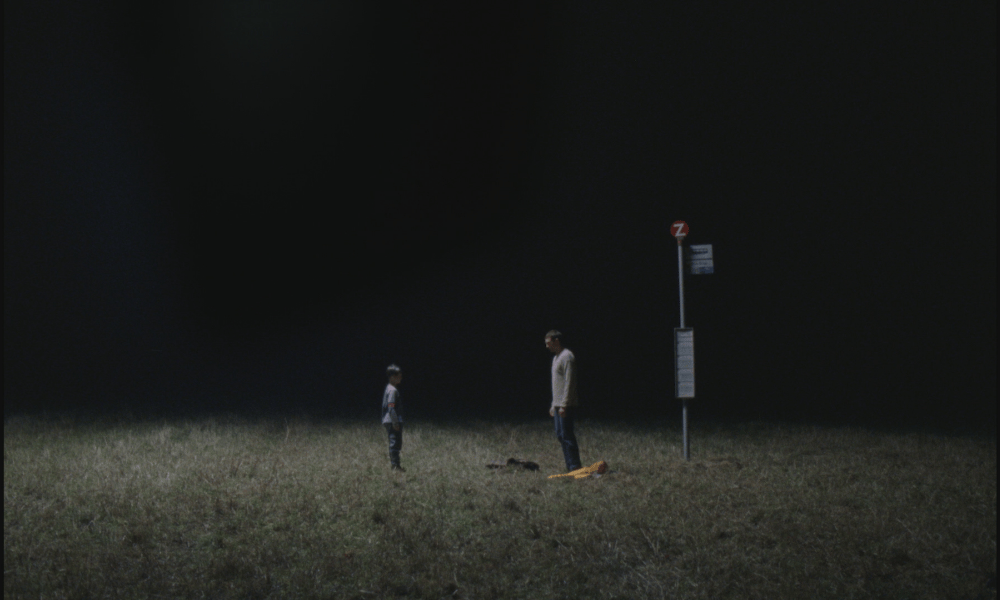
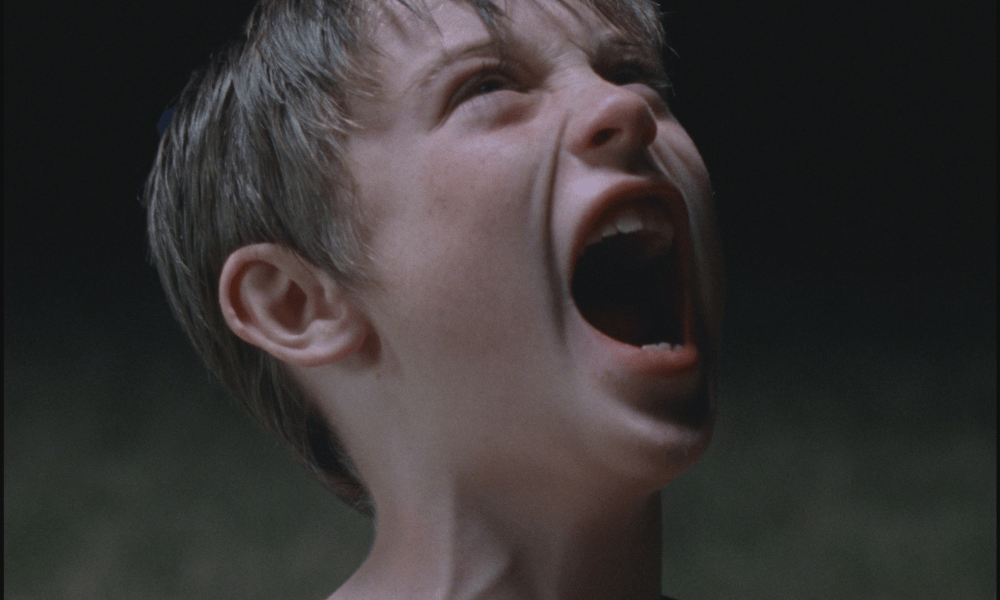
A pivotal moment in the sixteen-minute short comes when the same young boy finally stands before Flint in a field. They mirror each other’s movements, locked in a quiet standoff. Flint pulls on the child’s yellow coat, its seams tearing open. The boy screams. Then: “What’s it like being back?” his mother asks him in the kitchen. Flint can only answer, “The same.” The film shifts into revelation: the boy is Flint, the part of him he cannot escape. The yellow of the coat becomes the boy’s point of view, cut to present day shots of Flint in a jumper of the exact same shade, sealing the connection. A look back at a previous scene, where his father describes a dream the night before in which the walls were painted bright yellow, indicates that this colour, contrary to its traditional associations, represents something subconscious and sinister, passed down the generations.
Back home, Flint’s mother cares for the older relative again. Flint watches, asking, “Isn’t it strange how someone grows inside you, then they come out so big?” It’s tender, but edged with something volatile. Then, in a jolt, Flint cuts his wrist - not as self-harm in a literal sense, but as the resurfacing of a childhood sensation, a trauma repeating itself through the body. This is a man with pain and anger bubbling, trying to understand what he carries.
In the final stretch, Flint dries a knife slowly. The tension spikes. Is he going to hurt someone, or himself? The film refuses the obvious. Instead, Flint stands in the foreground while his parents dance softly in the background, he puts the knife down and joins in. They are a family shaped by something unspoken, but still a family.
Flint suggests that sometimes you must return home to move through what haunts you. We aren’t told exactly what happened, or where the trauma came from, but the film captures the unsettling, necessary process of confronting inherited pain, and hints, quietly, that healing is possible.
In the film’s final moments of quiet joy, Flint reminds us that even the darkest family histories can loosen their grip when finally faced with honesty and care.